The Series
The Black Hand: Myth vs. Reality
November 10, 2026 | 6 min read

In dozens of U.S. cities and across much of Italy in the late 1800s and early 1900’s, the arrival of an extortion letter marked with an inked black hand could quickly drain an immigrant’s savings. Newspapers called it a secret society that reached into every Italian neighborhood in the country. The man who fought it hardest, NYPD Det. Joseph Petrosino, knew the truth was different. In many ways it was more frightening than the legend.
The Black Hand was never an organization, a secret society, a malevolent organized gang watching and preying on vulnerable neighbors. It was a scam, a calling card of hundreds of desperate gangs and twisted opportunists eager to earn some dirty money.
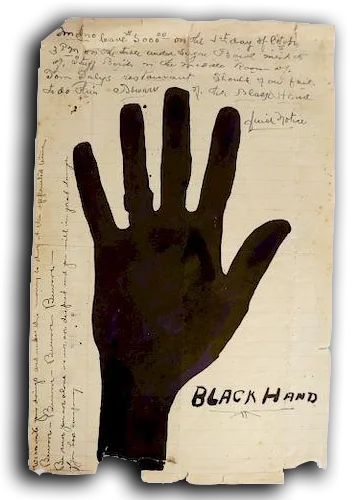
The envelope is delivered to a tenement on Mulberry Street. Inside is a short message in rough Italian: leave a sum of money at a certain place by a certain day, or your shop will burn, or your son will disappear. It sports a common drawing: a dagger, a coffin, a skull, a stiletto poised above a victim’s back, with drops of blood spurting. At the bottom is the image of a hand in black ink – sometimes drawn, sometimes imprinted by a real hand, in the age before fingerprint identification.
The man who opens it has probably new to America. He speaks little English, does not trust the police, and is aware of what happened to a nearby grocer who refused to pay. The deadline is close, and he has nowhere to turn.
For thousands of Italian immigrants at the turn of twentieth-century New York, the terror was overwhelming. It was the nightmare that plagued the Lower East Side, Italian Harlem, Brooklyn, Philadelphia and dozens of other cities.
The sender identified himself as La Mano Nera. The Black Hand. To the victims, and newspapers that grew its infamy, it was a vast invisible army. It was everything but.
The Italian “curse” began in Spain in the early 1880s, in Spain’s Andalusian region when an anarchist/communist fervor spread among trabajadores – working class union members – in the Barcelona, Andalusian region of Spain. Spain’s executions by garroting of nine trabajadores – and veneration of their judges by a popular Catholic Order – sent the Andalusian region into a frenzy of food raids and riots by a desperate lower class. In late 1882, authorities in Madrid sent in dozens of troops, arrested thousands of laborers, and found single handwritten document; “The Black Hand: Regulation of the Society of the Poor, against their thieves and executions…”
The press declared La Mano Nera a thirsty cabal of crazed assassins, controlled by demon heretics out to slay their benevolent masters. The Black Hand imprint may have been the smeared hand of the author, or his attempt to remain anonymous or hide his illiteracy. Either way, Italian criminals and opportunists – La Mano Nera is spelled and means the same in both languages – thought it a clever approach to easy money by fanning the fear among their neighbors.
The crime was older than the name. In southern Italy and Sicily, criminals had long sent threatening letters to landowners and merchants, demanding payment in exchange for safety. Immigrants brought it across the Atlantic. Fear is cheap and lucrative, requiring only paper, ink, and a reputation for violence that someone else had built.
The scam took hold in New York in 1903, after a Brooklyn extortion case involving a letter signed “La Mano Nera.” The press pounced and “Black Hand” became a headline for almost any crime in the Italian quarters: extortion, kidnapping, arson, bombing, murder.
It became a cottage industry. The more people believed the Black Hand was one great organization, an army of Sicilian Freddie Krugers, invisible but always lurking, the easier it was for a business partner or next door neighbor to borrow its power.
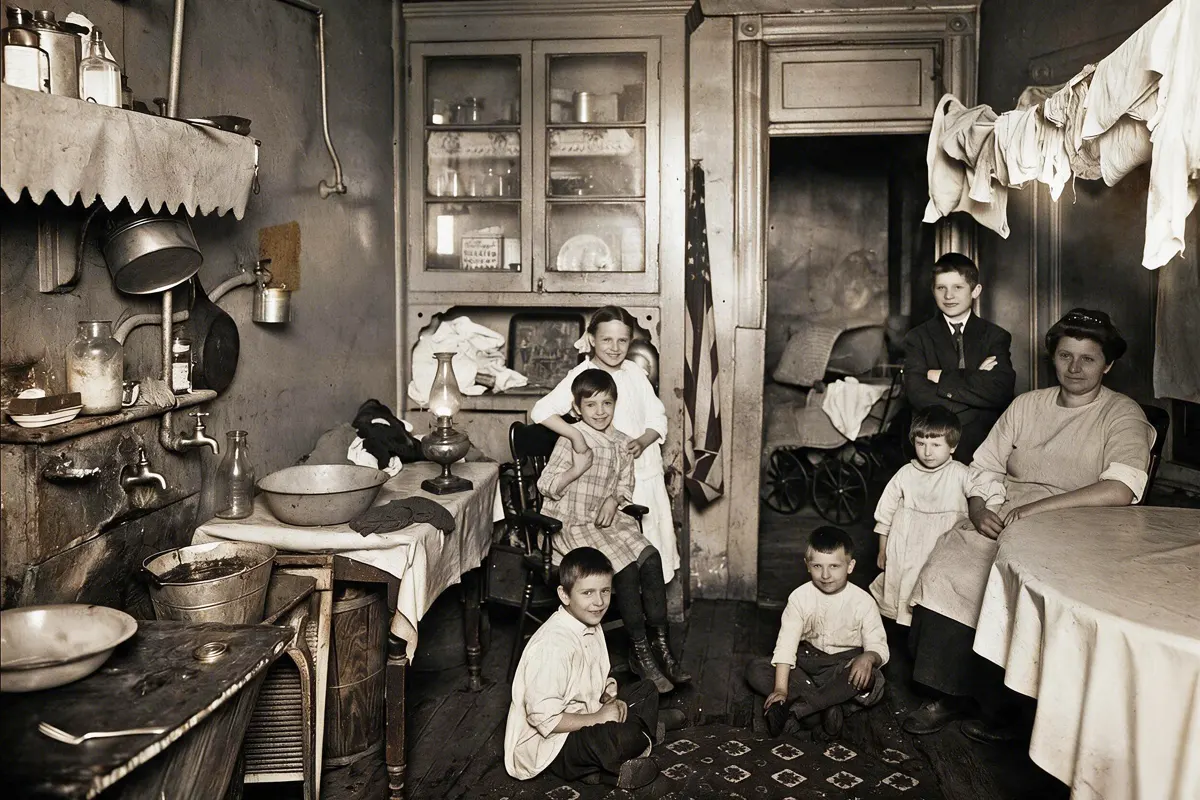
There was no Black Hand headquarters. No supreme boss, no initiation oath, no membership rolls. The letters came from lone opportunists and small neighborhood gangs. Sometimes it was the Mafia, Giuseppe Morello and Ignazio Lupo — the American Mafia’s “first family.” That family – cosca – eventually fell under the leadership of Charles “Lucky” Luciano, via the Mob’s unique method of self-promotion; he whacked the guys above him.
Once the name became a recognized brand, a stampede of converts appeared. The victims numbered in the thousands. Most likely 10’s of thousands throughout greater New York.
In 1908, Gaetano D’Amato, a former president of the United Italian Societies, published an essay titled “The ’Black Hand’ Myth” in the North American Review. He argued that the Black Hand criminals were “no more organized than the many thousands of lawbreakers of other nationalities in America,” and he blamed sensational press coverage for inventing a single society that did not exist.
The myth was convenient for almost everyone except the victims. It sold newspapers. It gave police an excuse when crimes went unsolved: who could be expected to defeat a shadowy, all-powerful secret society? It fed the racist notion that all Italian immigrants were the problem, rather than the people being preyed upon.
The big boogey man image relied on the hyena effect – isolate, outnumber, surround, attack. Black Hand targets were usually immigrants with some success: shopkeepers, bankers, builders, landlords, with nowhere to turn. Police officers spoke no Italian and were not likely to protect a family from extortionists they could not identify. So, they paid, and paying once meant paying again until their twisted paesani bled them to ruin.
When letters failed, bombs followed. In James Dalessandro’s Playboy magazine account of the long festering nightmare, the devices evolved quickly. A paper bag of black powder with a cloth fuse, set off outside a pharmacy at Park and Mulberry streets as a warning. That evolved to olive-oil cans packed with powder. Dynamite stolen from subway and road construction sites, wrapped in nails and scrap metal to extend the horror. The finale was pure high-tech – wind-up clocks used as timers.
In September 1906, wire reports carried around the world described a five-story New York tenement dynamited while nearly a hundred people slept inside. The building belonged to an Italian banker under a Black Hand death threat. The blast tore away the front of the house and left the terrified tenants exposed to the street, clinging to their furniture.
A threat aimed at one man was now a danger to an entire building full of people. Extortion had turned into terrorism.
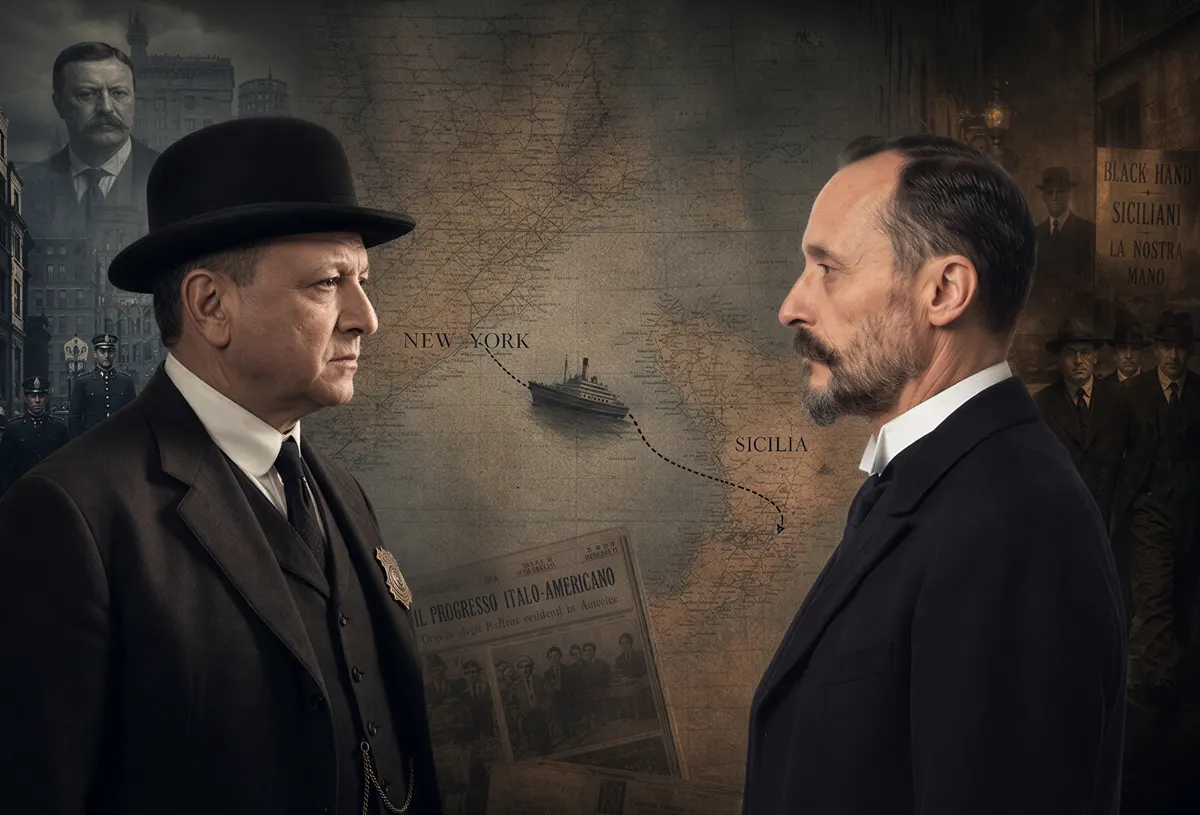
Joseph Petrosino, an orphaned former shoeshine boy, joined the New York Police Department in 1883, the first Italian speaking officer in its history. He was 5’3” tall and 200 pounds, which required a special dispensation from the mandatory 5’8” NYPD requirement. For years he argued that the department could not protect the Italian neighborhoods without detectives who understood their language, dialects, and customs. In 1895, the new President of the Police Commission, a squeaky voice politician with a relentless commitment to reform – Theodore Roosevelt – promoted Petrosino to Detective.
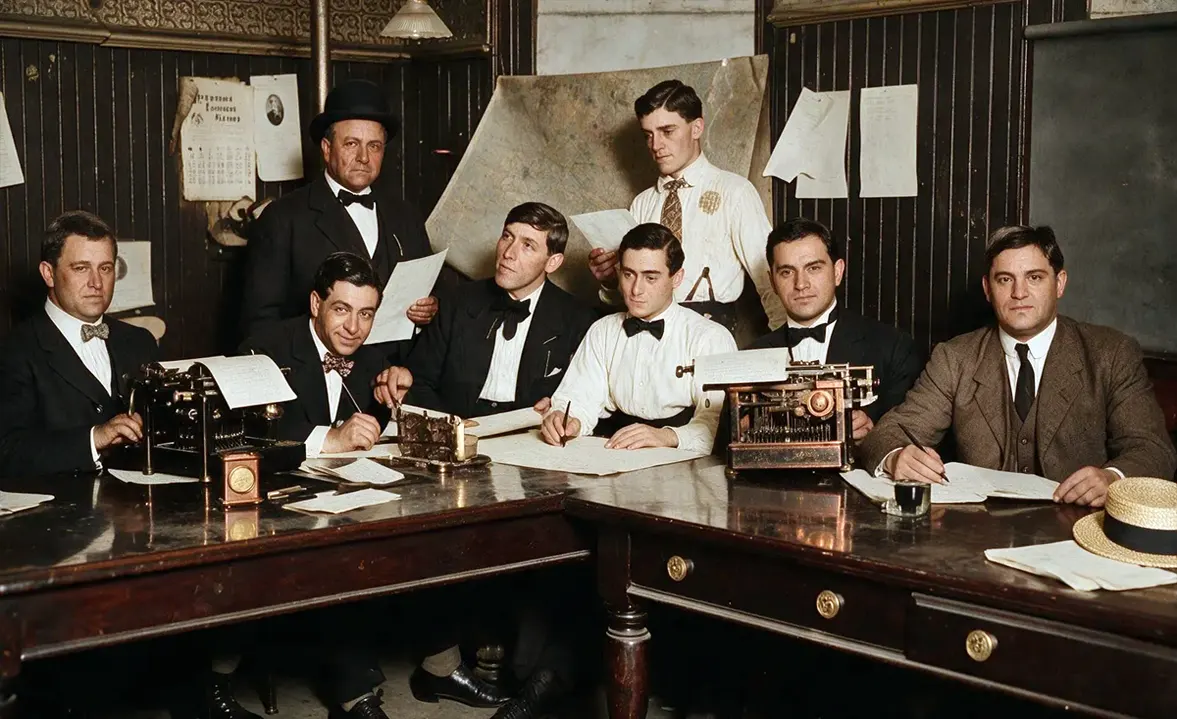
In 1904 the department authorized Petrosino’s creation of The Italian Squad, the nation’s first “Untouchables” decades before Elliot Ness’s arrival in Chicago, granting him five men instead of the larger unit he had asked for. The Italian Squad had no office at first; Petrosino’s own apartment served as its headquarters. Within two years, its success had persuaded the department to expand it several times over.
Petrosino helped revolutionize police work. He traveled in disguise, built networks of informants, and started photo arrays of organized gangs. He personally confronted the men behind the threats, earning two nicknames. The Italian Sherlock Holmes for his genius at crime solving. And The Dentist for the number of teeth surrendered by incalcitrant gangsters and Mafiosi during their confrontations.
During his run at the Metropolitan Opera, the great tenor and first million selling recording artist Enrico Carusor received Black Hand letters demanding thousands of dollars. Petrosino, an avid fan, set a trap for the extortionists. They were arrested at the drop.
Dalessandro’s account of Petrosino’s career includes one of the most dramatic episodes of all. Francesco Spinelli, owner of a tenement on East 11th Street, had refused payment over a threat to kidnap his young son. Petrosino trailed the extortionist, Giuseppe Bonaventura, into the tenement that housed the Spinelli family and dozens of others. When the burly Bonaventura lit the fuse on a crude bomb, Petrosino tackled him, pinched out the flame, and pummeled him into a bloody surrender.
The bombings changed police work. The NYPD Bomb Squad traces its origins to Petrosino and the Italian Squad, and in 2003 the department celebrated the unit’s hundredth anniversary in his honor. A formal Bomb Squad was organized in 1914, built partly from Italian Squad veterans.
Petrosino fought the Black Hand myth in the streets and in the newspapers. He insisted that a huge majority of Italian immigrants were law-abiding and hardworking. The press and public preferred the myth.
The myth: The Black Hand was a vast secret society controlling extortion across America.
The reality: It was a method, not an organization. Many unconnected criminals and gangs used the same name and symbols to make their threats seem bigger than they were.
The myth: The Black Hand and the Mafia were the same thing.
The reality: Some Mafia figures practiced Black Hand extortion, but the Mafia was a structured criminal organization with its own hierarchy. Their crimes included gambling, prostitution, drugs, hijacking, murder, burglary, political and institutional corruption, labor exploitation and more. None had the buzz and easy moniker of The Black Hand.
The myth: The Black Hand proved that Italian immigrants were a criminal threat.
The reality: Italian immigrants were overwhelmingly its victims. The criminals preyed on their own neighbors precisely because those neighbors had the fewest places to turn.
Behind the myth of the Black Hand was something far more dangerous. Petrosino’s investigation of the Barrel Murder of 1903 led him to the Morello-Lupo gang, the first American Mafia family. It also led him to Vito Cascioferro, a Mafioso who fled Sicily in 1901 to avoid arrest for murdering Emanuele Notarbartolo, President of the Bank of Sicily, who had uncovered Cascioferro’s vast fraud. Petrosino arrested Cascioferro in 1903; he was acquitted and sailed to Sicily, where he continued as Boss of Bosses of the Sicilian Mafia.
In early 1909, new Police Commissioner Theodore Bingham sent Petrosino to Palermo to find intelligence on Sicilian criminals in the U.S. On March 12, 1909, Petrosino was shot dead in Palermo’s Piazza Marina by Cascioferro himself, or Mafiosi acting on his orders.
His murder sealed his fame and raised him to martyr status when 250,000 New Yorkers, 10th of the entire population of the five boroughs, lined the streets for his funeral.
Read next: Who Was Joseph Petrosino? · Follow the story on screen: The Series
• James Dalessandro, ”Petrosino: The Man Who Fought the Mafia,” Medium.
• Gaetano D’Amato, “The ‘Black Hand’ Myth,” The North American Review 187 (April 1908): 543-549.
• Paul Moses, The Italian Squad: The True Story of the Immigrant Cops Who Fought the Rise of the Mafia (NYU Press, 2023).
• Stephan Talty, The Black Hand: The Epic War Between a Brilliant Detective and the Deadliest Secret Society in American History (Houghton Mifflin Harcourt, 2017).
• J. E. Fishman, Dynamite: A Concise History of the NYPD Bomb Squad.
• The Mob Museum, “The inspiring rise and tragic fall of the ‘Italian Sherlock Holmes’.”
• Mafia Genealogy, “What was the Black Hand?”
• Encyclopaedia Britannica, “Black Hand.”