The Series
Who Was Joseph Petrosino?
October 19, 2026 | 6 min read

On the night of March 12, 1909, a stocky man in a derby hat walked into Piazza Marina in Palermo to meet an informant. He never left. So who was Joseph Petrosino, and why did his murder, four thousand miles from New York, make headlines on both sides of the Atlantic?
He was an Italian immigrant who became one of the most remarkable detectives in the history of the New York Police Department. Long before the Mafia became a staple of American mythology, Petrosino was already tracking it across an ocean.
New York at the turn of the twentieth century was a city of crowded tenements, unfamiliar languages, and rapidly changing neighborhoods. For many newly arrived immigrants, the police were an institution they neither trusted nor understood. Fear, poverty, and language barriers made it hard to ask for help.
Joseph Petrosino understood this world from the inside.
He had grown up in it. Before he ever wore a badge, he was a boy working the streets of Manhattan, a newsboy and shoeshine boy among the immigrant families of the Lower East Side. When he became a detective, he could move through those streets in ways few of his colleagues could.
He recognized that criminals preying on Italian immigrants could hide behind the very barriers that separated those communities from the authorities. Effective policing, he believed, required more than a badge and a uniform. It required knowledge, persistence, and the ability to earn information from people who had every reason to stay silent.
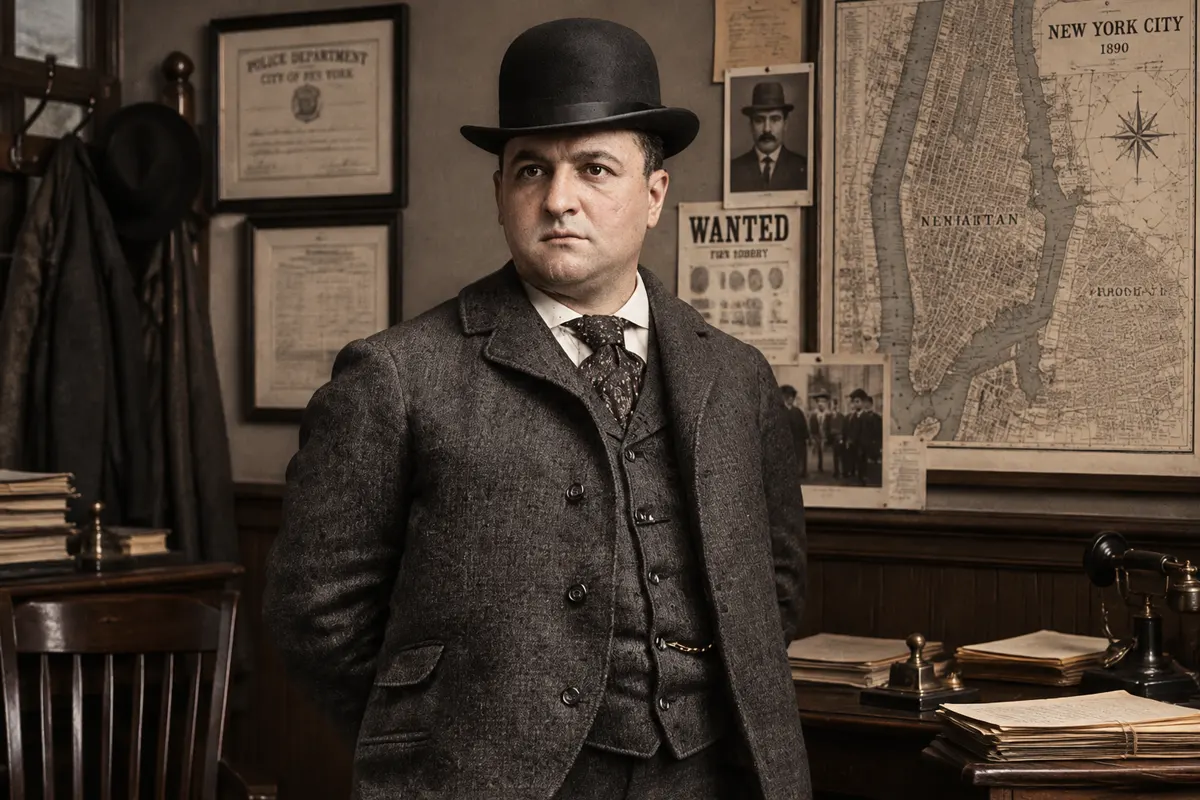
Joseph Petrosino was born Giuseppe Petrosino on August 30, 1860, in Padula, a town in the province of Salerno in southern Italy. He was the son of a tailor.
Like countless other Italians of his generation, he left for the United States in search of opportunity. He arrived in New York in 1873, still a boy, and grew up in a city where immigrant families were building new lives under difficult conditions.
That upbringing gave him an understanding of the Italian community that few officers of his era possessed. He knew the language and the traditions. He could tell the difference between ordinary neighborhood life and the networks of fear that criminals tried to build inside it.
In 1883 he joined the New York Police Department, a force that was struggling with rapid population growth, political corruption, and new forms of organized crime. He was not an imposing figure. He was short, in fact: he fell four inches below the department’s height requirement when he was hired. As a detective, he reportedly wore thick-soled shoes and a tall derby hat, which became his trademark and earned him the nickname “the detective in the derby.”
What made up for his stature was observation, patience, and a talent for moving between worlds that usually stayed separate. Newspapers called him “Joe.” His admirers called him “Bulldog Joe.”

Petrosino’s investigations often took him well beyond the reach of a conventional police officer. His command of Italian language and customs opened doors that were closed to other detectives. Disguises and undercover methods let him gather information without revealing who he was.
The work demanded more than courage. It demanded an understanding of human behavior: knowing when to listen, when to ask questions, and when to let others underestimate him.
In neighborhoods where criminals relied on secrecy and intimidation, information was hard to obtain. Victims feared retaliation. Witnesses hesitated. Even those who wanted the violence to stop were reluctant to speak openly.
Petrosino’s cases drew attention to the extortion schemes known as the Black Hand. The name described a method rather than a single organization: threatening letters demanding money from Italian immigrants, often signed with a black handprint, a dagger, or a skull. The threats were frightening and deeply personal. Refusing to pay could mean a bomb on the doorstep, a kidnapped child, or a ruined business.
Historians still debate how much the Black Hand overlapped with the Sicilian Mafia and with similar groups from Naples and Calabria. What is clear is that many of the men behind these threats came from, or were connected to, criminal circles in southern Italy, and that Petrosino took the connection seriously.
For him, these were never abstract cases. The victims were people who had crossed an ocean hoping for safer, more secure lives.
In 1895, Theodore Roosevelt, then president of the city’s Board of Police Commissioners, promoted Petrosino to detective sergeant. No Italian American had ever held a position that high in the department. Roosevelt, a reformer who admired results, became one of Petrosino’s most important supporters. When Petrosino died, Roosevelt said of him: “he did not know the name of fear.”
By January 1905, Police Commissioner William McAdoo had put Petrosino in charge of a small squad of Italian-speaking detectives, a unit that became known as the Italian Squad. Its mission was to investigate crimes that conventional methods could not reach, particularly when suspects and victims had ties beyond New York. In 1908, Petrosino was promoted to lieutenant.
The Italian Squad reflected a new idea in American policing: that language skills, cultural knowledge, and cooperation across borders could be as valuable as force. But the work carried real risk. Criminal networks operated across cities and countries, while the police faced legal and practical limits on gathering information abroad.
Petrosino was determined to push past those limits.
Again and again, Petrosino’s investigations pointed across the Atlantic. Arresting an extortionist in New York did not necessarily dismantle the operation behind him. If threats, extortion, and fugitives moved between Italy and America, the police needed to understand the people and relationships on both sides.
The challenge was larger than any single arrest. He was trying to understand a network that could rely on secrecy, personal loyalty, and the difficulty of international cooperation. To do that, he would have to go where it began.
In early 1909, Petrosino sailed for Italy on a confidential mission. He traveled under an assumed name and, once in Sicily, registered at his Palermo hotel under another. His goals were specific: to collect criminal records on Italian fugitives living in New York, to build a network of informants, and to work with Italian authorities to stop criminals from crossing the Atlantic.
The mission was supposed to be secret, because criminals in Italy and Sicily had already threatened his life. It did not stay secret. The New York Herald revealed his trip on February 20, 1909, a day before his ship docked in Genoa, and the news spread through newspapers on both sides of the ocean.
On March 12, 1909, after dinner at a Palermo café, Petrosino walked into Piazza Marina to meet an informant. At close range, gunmen shot him. He was unarmed. He was 48 years old.

Petrosino was shot in Piazza Marina in Palermo on the evening of March 12, 1909. The attack was brutal, and it shocked New York. A police officer who had spent his career confronting criminal networks in America had been killed while investigating their connections abroad. He remains the only New York police officer killed in the line of duty outside the United States.
Italian authorities suspected Vito Cascio Ferro, a Sicilian mafia boss whom Petrosino had mentioned in his notebook the day before his death. The charges were quietly dropped in 1911, and the assassination is still officially unsolved. A legend says Cascio Ferro later boasted of firing the fatal shot himself, but historians treat that story with caution.
Whatever the exact chain of responsibility, Petrosino’s murder became a lasting symbol of the price paid by those who challenge organized crime.
It is easy to remember Petrosino only as a fearless detective. His life was not defined by police work alone.
In 1907 he married Adelina Saulino, and in November 1908 their daughter was born, also named Adelina. She was about three months old when her father sailed for Sicily. She never knew him.
Behind the public figure was a husband and a new father whose professional commitments carried a heavy cost for those closest to him.
Petrosino’s story also reflects the experience of a generation of immigrants who built lives in America while keeping deep ties to the places they had left. His familiarity with both Italian and American society was central to his work, letting him see connections that others overlooked.
Petrosino’s body was returned to New York in April 1909, and his funeral became one of the largest public events the city had seen. An estimated 250,000 New Yorkers lined the route of the procession, which included mounted police, a regiment of a thousand officers on foot, Italian societies, marching bands, and carriages of flowers.
For many Italian Americans, his death carried a particular meaning. At a time when Italian immigrants were often treated with suspicion and prejudice, Petrosino had stood against the criminals who preyed on their own communities. He challenged the idea that those communities were defined by the crimes of a few, and he worked to protect ordinary families from those who used fear and silence as instruments of control.
Joseph Petrosino’s life belongs to a formative period in American law enforcement. His investigations drew attention to the international reach of organized crime, and to the need for police work informed by language, culture, and cooperation across borders.
His story also holds a broader lesson. Organized crime thrives where people feel isolated, where victims are afraid to speak, and where institutions struggle to understand the communities they serve. Petrosino worked at the center of all three problems. He knew that fighting crime meant understanding the people most affected by it, and that following the evidence sometimes meant following it across an ocean.
More than a century after his death, his name still stands for courage, public service, and the pursuit of justice.
This is the second article in the Petrosino series. If you missed the first, read The Story Behind Petrosino, which explores how James Dalessandro’s 2010 Playboy investigation brought this forgotten detective back into public view. The series that follows takes viewers into the world he confronted: early twentieth-century New York, the immigrant communities he served, and the criminal networks that reached far beyond the city.
His story began in southern Italy, took shape in New York, and ended in Sicily. It did not end there.